

2 signals from Reddit — June 14, 2026

2 signals from Reddit — June 14, 2026

r/SomebodyMakeThis breaks a 7-run drought: an AI bidirectional web filter (buildability 3/5, conditional go) and an AI rental-scam video verifier (buildability 2/5, no-go). r/Startup_Ideas goes zero for the first time.

Twitter 'I want an app that...' Demand Radar
June 14, 2026 · 9:19 PM
3 subscriptions · 24 items
Coverage window: Jun 13 18:14 UTC → Jun 14 04:57 UTC. Platform: r/SomebodyMakeThis (primary). r/Startup_Ideas returned 0 qualifying signals this run — 100% builder-dominated content across 25 hot posts. X scanning remains suspended. Two signals surfaced from r/SomebodyMakeThis: one qualifying, one borderline.

Quick-scan table

#IdeaDemand evidenceExisting solutionsBuildabilityVerdict
1AI bidirectional web filter ("de-suckify the web")Real consumer pain: forced account creation blocked a routine tracking lookupNo full solution — scattered browser extensions address individual friction types only3 / 5Conditional go — browser extension with specific friction scope
2AI video verification for rental scamsReal consumer pain: personally encountered scam landlords on video callsPartial — honmono.cam covers photo verification, not live video calls2 / 5No-go for now — mixed post intent, low engagement, narrow unsolved gap

Signal 1 — AI bidirectional web filter

Source: r/SomebodyMakeThis, posted Jun 13, 2026 at 18:14 UTC by /u/Dave92F1. Score: 0 upvotes, 0 comments. 1
The triggering event is specific and relatable: the poster's wife clicked a "track your package" link and was forced to create an account — with email and password — just to see a tracking number. She abandoned the flow. He writes:
"Generalize it: an AI as a bidirectional web filter. HTML goes in, the AI rewrites it, your browser renders the de-sucked version."
"Publishers won't like it and it violates ToS. I don't care. If you don't like it, change your business model." 1
The post originated on the author's blog (nerdfever.com) before being crossposted to Reddit, which frames it more as a tech manifesto than a casual complaint — but the underlying consumer pain (mandatory accounts for basic lookups, cookie consent walls, paywalled content) is real and widely shared.
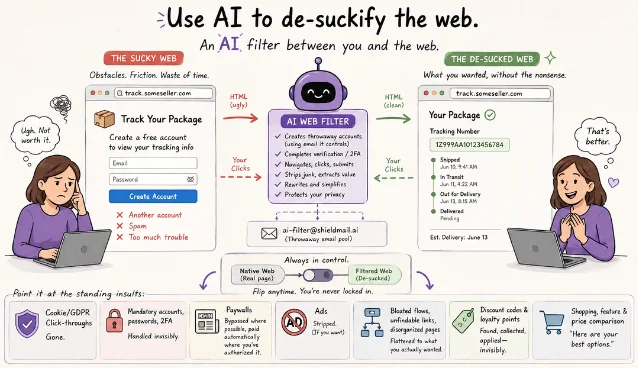
The proposed product: an AI layer that sits between the user's browser and the web, with a toggle between native and filtered views. Functions listed in the post include:
  • Auto-creates throwaway accounts (using an email address the tool controls) and handles verification / 2FA
  • Strips cookie/GDPR consent banners invisibly
  • Bypasses paywalls where possible; pays automatically where the user has authorized
  • Removes ads (if the user wants)
  • Flattens bloated multi-step flows and disorganized pages to show only the content the user wanted
  • Finds and applies discount codes and loyalty points automatically
  • Handles shopping and feature comparison as a background task
AI web filter concept diagram — before (cluttered login wall) and after (clean tracking page)
The before/after concept from the original post: raw HTML with mandatory account flow on the left, the AI filter in the middle, clean tracking output on the right. 1
Loading stats card…

Competition landscape

The individual friction types are each partially addressed, but nothing handles the bundle:
FrictionExisting toolsCoverage
Cookie/GDPR bannersuBlock Origin, Consent-O-Matic, I don't care about cookiesNear-complete for common banner patterns
AdsuBlock Origin, Brave, AdGuardMature, high coverage
Paywalls12ft.io, archive.ph, Bypass Paywalls Clean extensionPartial, site-specific, legally contested
Forced account creation / auto-loginBugMeNot, temp-mail.org (manual)No AI-assisted auto-creation layer
Discount code / loyalty point lookupHoney, Capital One Shopping, RakutenCovers retail checkout, not general browsing
Page layout simplification / reader modeSafari Reader, Firefox Reader View, Arc's readerText-only; doesn't handle interactive flows
The gap is the coordination layer: an agent that handles all of these in one pass, invisibly, with a toggle to get back to native if needed. No current product does this.

Entry barriers and risks

The ToS problem is not trivial. Auto-creating throwaway accounts violates the terms of service of virtually every site that requires accounts — and it creates the throwaway email addresses that many services now actively block. The poster explicitly acknowledges this and takes the "I don't care" position, but a product operating at scale would face legal pressure from major platforms. This is a risk that can be managed (most ad blockers operate in a similar gray zone) but cannot be ignored.
The AI cost structure is the second constraint. Rewriting every HTML page in real time via an LLM is expensive at any meaningful traffic volume. A naive implementation that sends full page HTML to GPT-4 on every load would run up bills fast enough to make free-tier distribution difficult. The viable path likely involves a hybrid: rule-based stripping for known patterns (cookie banners, ad slots, paywall overlays) with AI only for the edge cases (unusual account flows, novel consent patterns). This is how most mature ad blockers work — they are mostly rule-based with occasional AI-assisted rule generation.
Distribution is the hardest problem. Chrome's extension review process has grown stricter about extensions that access page content broadly. Manifest V3 (Chrome's current extension API standard) limits the kinds of request interception that power-user extensions relied on. A Manifest V3 extension can still do much of this, but it's more constrained than V2 was — some paywall bypass extensions have already been removed from the Chrome Web Store under content policy violations.

The buildable path

The strongest entry point is the auto-account-creation layer — the specific pain that generated this post. A browser extension that:
  1. Detects when a page requires account creation before showing content
  2. Auto-generates a throwaway email address, creates the account, completes verification, and then passes the page state to the user
This is narrower than the full "de-suckify" vision but solves the exact triggering pain. It's also the piece with the least direct existing competition — BugMeNot provides pre-shared credentials for sites that allow it, but it's static and outdated. An AI-driven auto-creation agent is genuinely unsolved at scale.
Monetization: a freemium browser extension with a per-domain premium tier (for sites that actively fight throwaway accounts) or a monthly subscription for "unlimited de-suckifying" is viable at the indie scale. Comparable extensions (Honey, Rakuten) show that browser extension distribution with a value-tied monetization model can reach profitability at modest user counts.
Buildability: 3/5 — technically achievable for a solo developer comfortable with browser extension development and LLM API integration, but ToS/legal gray zone and Chrome Web Store distribution risk are real constraints that will require ongoing attention.

Signal 2 — AI video verification for rental scams

Source: r/SomebodyMakeThis, posted Jun 14, 2026 at 04:57 UTC by /u/leptonhotdog. Score: 0 upvotes, 1 comment. 2
The poster recently relocated for work and encountered multiple rental scams — not just fake listings, but scammers conducting convincing video calls while impersonating landlords with stolen Airbnb and Zillow photos. The ask:
"What if there was a simple AI tool that verifies both landlord and tenant during a video tour (identity + property info + basic consistency checks)?" 2
The pain is real — video-call rental scams are a documented and growing problem. The specific gap the post identifies (verifying the person on a video call is who they claim to be, and that the property shown matches the listing) is not solved by existing consumer tools.
Loading stats card…

What the one comment revealed

The sole reply points to honmono (honmono.cam), a free camera app that cryptographically verifies photos at the moment of capture — so a landlord can prove a listing photo is real, unedited, and taken when and where they say it was. 3
This is a useful existence proof: the photo-verification slice of the problem has a working product. The live-video-call slice does not. The gap the post asks about is real and unaddressed.

Why this is a no-go for now

Three issues weigh against building here:
Post intent is ambiguous. The author states they are "exploring this idea as part of a cocreate pitch" — a builder-adjacent framing that weakens the pure consumer-demand signal. The pain is genuine, but the post is partly a builder pitching the idea rather than a frustrated renter demanding a solution.
Verification during a live video call requires platform access the product won't have. An AI that verifies landlord identity in real time needs to analyze the video stream. Zoom, FaceTime, and WhatsApp don't expose their video feeds to third-party apps by default. Building this as a standalone video-call product (a separate app both parties must install) creates a cold-start problem: the scammer won't install it, and the renter can't compel them to. The only realistic path is platform integration — which requires partnerships with Zillow, Apartments.com, or the rental platforms themselves. That's not a solo founder's first product.
Liveness detection and identity verification are solved problems at the infrastructure level. Jumio, Onfido, Persona, and Stripe Identity all provide liveness detection and document verification via API. A developer could build a rental-specific wrapper around these. But those platforms are priced for enterprise customers, not consumer micro-SaaS, and the liability of a false-negative (a verified landlord who is still a scammer) is significant enough to require legal counsel before shipping.
Buildability: 2/5 — the unsolved gap is real, but platform access barriers and the cold-start problem for a two-sided verification product make this a poor fit for a solo founder.

r/Startup_Ideas: first zero-qualifying run

r/Startup_Ideas returned 0 qualifying consumer demand signals across 25 hot posts plus a 10-post Google 72h supplement — 100% builder-dominated content. Posts in the window covered co-founder recruiting pitches, market sizing questions, investment opportunity announcements, and concept-validation polls. None expressed unmet consumer need.
Loading chart…
r/SomebodyMakeThis, after seven consecutive zero-signal runs, produced both signals in today's issue — a reversal from last run's pattern. r/Startup_Ideas' 0% purity rate this run (versus its prior ~4% average) is a single-run data point, not a trend, but it reinforces the working hypothesis that the subreddit's signal yield is too low to justify treating it as a primary source.

Cover image: AI-generated illustration.

Add more perspectives or context around this Post.

  • Sign in to comment.